
Resource
Quran and Ramadan: source posters
Nine posters from the original Quran collection, with readable text and source references.
Nine illustrations from the original Quran collection. Select an image to open it at full size. On narrow screens, scroll tables sideways; keyboard users can focus a table region and use the arrow keys.
Ramadan in the Quran

شَهْرُ رَمَضَانَ الَّذِي أُنْزِلَ فِيهِ الْقُرْآنُ
Opening words of Quran 2:185. Read the complete verse and translations on Quran.com.
Ramadan greetings in different languages

The poster’s introduction reads:
Every language has its own linguistic heritage for how one blesses someone for Ramadan. The greeting “Ramadan Kareem” is rooted in Arabic and is the most commonly used. It means to have a blessed, generous Ramadan.
Language labels and phrases as shown in the poster:
- Persian: ماه رمضان مبارک
- English: Ramadan Mubarak
- Arabic: رمضان كريم
- Turkish: Ramazan ayınız Mübarek olsun
- Hindi: रमजान मुबारक
- Somali: Soon Wanaagsan
- Bengali: রমজান মোবারক
- Bahasa Malaysia: Selamat Berpuasa
- Spanish: Feliz Ramadán
- Urdu: رمضان مبارک
Poster credit: AJ Labs / Al Jazeera. Related publisher page with greeting cards and audio.
What is Laylat al-Qadr?

Text from the poster:
Laylat al-Qadr, or the night of power, is when the first verses of the Quran were revealed to the Prophet Muhammad inside the Cave of Hira. While the exact date of Laylat al-Qadr is unspecified, it is believed to occur on one of the odd-numbered nights during the final 10 days of Ramadan.
Ramadan lasts either 29 or 30 days, depending on the sighting of the moon. Here is what the moon looks like on each night of the month.
The Cave of Hira is located in a mountain outside the city of Mecca.
The diagram labels days 1–30 and shows the moon waxing and waning. Stars mark nights 21, 23, 25, 27 and 29 with the label “Laylat al-Qadr”. These are illustrative phase images, not a local moon-sighting calendar or confirmation of a particular night.
Reference for seeking the night during the odd nights of the last ten: Sahih al-Bukhari 2017.
A day in Ramadan

Poster heading: Ramadan marks the revelation of the Quran.
The Quran was first revealed during the month of Ramadan, the ninth month of the Islamic lunar calendar and the month of fasting and reflection.
The diagram is labeled “What a day in Ramadan comprises”. It shows night, day, sunrise and sunset, and names five daily prayers: Fajr, Duhur, Asr, Magrib and Isha (spellings as printed).
- SUHUR
- The predawn meal.
- SAWM (FASTING)
- The poster describes fasting from dawn to dusk for adults who are physically able, abstaining from eating, drinking, smoking and sexual relations to develop greater “taqwa”, or consciousness of God.
- IFTAR
- The evening meal that breaks the fast.
This is a schematic daily routine, not a local prayer timetable. Dawn and sunrise are distinct; use local prayer times for actual timings.
Source for these two graphics: Al Jazeera — Visualising the Quran. The original images are unchanged; the adjacent text makes their contents readable.
The 33-year Ramadan cycle
The original poster illustrates how Ramadan moves through the seasons. Its printed dates are reproduced below as estimates from the source, not confirmed observance dates. The poster itself says “subject to moon sighting”. Consult your local community’s announcement for the actual start of Ramadan; this graphic is not a current calendar.
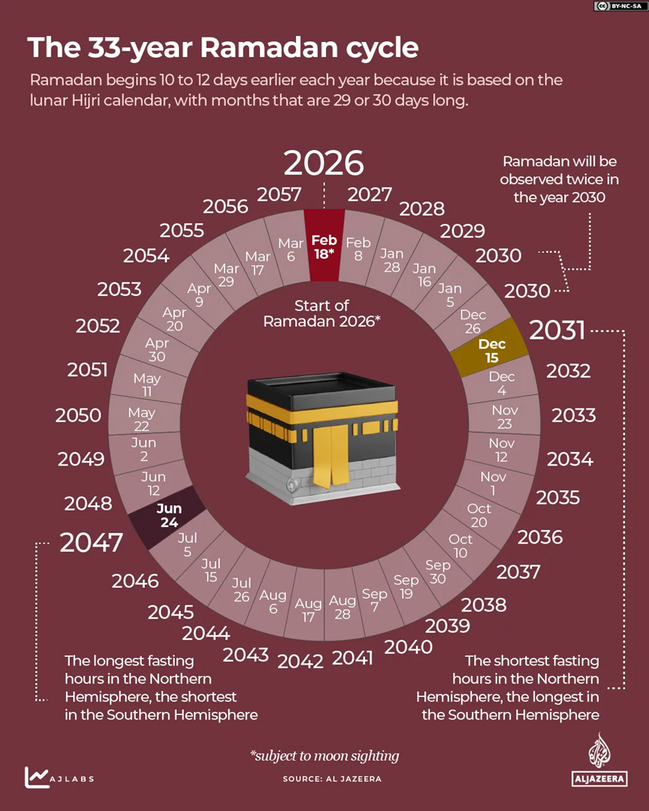
The poster explains that Ramadan starts 10 to 12 days earlier each year in the solar calendar because Hijri lunar months last 29 or 30 days. Its ring contains 33 start-date entries across 32 calendar years, including two entries for 2030.
The graphic highlights December 2031 as the shortest northern-hemisphere fasting season and June 2047 as the longest, with the seasons reversed in the southern hemisphere. These are broad seasonal illustrations; actual daylight and fasting arrangements depend on location.
| Year | Printed estimate |
|---|---|
| 2026 | February 18 |
| 2027 | February 8 |
| 2028 | January 28 |
| 2029 | January 16 |
| 2030 | January 5; December 26 |
| 2031 | December 15 |
| 2032 | December 4 |
| 2033 | November 23 |
| 2034 | November 12 |
| 2035 | November 1 |
| 2036 | October 20 |
| 2037 | October 10 |
| 2038 | September 30 |
| 2039 | September 19 |
| 2040 | September 7 |
| 2041 | August 28 |
| 2042 | August 17 |
| 2043 | August 6 |
| 2044 | July 26 |
| 2045 | July 15 |
| 2046 | July 5 |
| 2047 | June 24 |
| 2048 | June 12 |
| 2049 | June 2 |
| 2050 | May 22 |
| 2051 | May 11 |
| 2052 | April 30 |
| 2053 | April 20 |
| 2054 | April 9 |
| 2055 | March 29 |
| 2056 | March 17 |
| 2057 | March 6 |
The February 18, 2026 entry carries an asterisk referring to the poster’s moon-sighting note. All dates above are a transcription, not a recalculation or confirmation.
Numerical charts from the original collection
The following four graphics preserve the original publisher’s presentation. Their figures and spellings are transcribed below; they are not independently verified statistics. The graphics do not provide reproducible lists of counted words or verses. Counts of words, names, concepts and references are different measures. The Quranic Arabic Corpus search guide distinguishes stems, lemmas, roots and concepts; a result depends on the query used.
What is mentioned in the Quran?

The poster describes the Quran as guidance for humanity, covering God’s oneness, moral behaviour, social conduct and prophetic stories. It presents the following pairs as word-count symmetries.
| First label | Count | Second label | Count |
|---|---|---|---|
| Good deeds | 167 | Wrong doings | 167 |
| Life | 145 | Death | 145 |
| Everyday life | 115 | The afterlife | 115 |
| Angels* | 88 | Devils* | 88 |
| Guidance* | 79 | Mercy* | 79 |
| Calamity* | 75 | Thanksgiving* | 75 |
| The mind* | 49 | The light* | 49 |
| Adam | 25 | Jesus | 25 |
| Man | 24 | Woman | 24 |
* The poster says these figures include derivatives, but does not specify the included Arabic forms. The other rows also lack a reproducible counting method.
| Label | Printed count | Poster comparison |
|---|---|---|
| Day | 365 | Days in a year |
| Days | 30 | Days in a month |
| Month | 12 | Months in a year |
| Establish prayer | 5 | Mandatory prayers per day |
These comparisons are the publisher’s claims, not a validated numerical pattern. The table does not establish which word forms were included or excluded.
Names of Allah: source chart

The introduction says that, among the 99 names of God, 56 begin with “Al” or “The one” and are specifically mentioned in the Quran; it refers to hadith for other names. This is the poster’s wording, not a linguistic definition of the Arabic article or a verified classification. The 56 entries below retain its transliterations and English glosses, including the distinct labels Al-Qadeer and Al-Kadeer. No Arabic-word list or counting method is supplied.
| Name label | Count | English gloss |
|---|---|---|
| Al-Aziz | 60 | The Almighty |
| Al-Rahmaan | 48 | The Beneficent |
| Al-Hakeem | 38 | The All-wise |
| Al-Raheem | 34 | The Merciful |
| Al-Aleem | 32 | The All-knowing |
| Al-Samee’ | 19 | The All-hearing |
| Al-Haqq | 11 | The Absolute truth |
| Al-Ghafoor | 11 | The Ever forgiving |
| Al-Hameed | 10 | The Praiseworthy |
| Al-Ghaniy | 8 | The Wealthy |
| Al-Tawwab | 6 | The Relenting |
| Al-Khabeer | 6 | The All-aware |
| Al-Azeem | 6 | The Magnificent |
| Al-Alee | 6 | The Supreme |
| Al-Qahhar | 6 | The All-prevailing |
| Al-Waahid | 6 | The One |
| Al-Kabeer | 5 | The Greatest |
| Al-Baseer | 4 | The All-seeing |
| Al-Hayy | 4 | The Ever-living |
| Al-Malik | 4 | The King |
| Al-Ala | 3 | The Highest |
| Al-Ghaffar | 3 | The Absolute forgiver |
| Al-Qayyoom | 3 | The Sustainer |
| Al-Wahhab | 3 | The Supreme bestower |
| Al-Khalaaq | 2 | The Creator |
| Al-Qaher | 2 | The Absolute vanquisher |
| Al-Quddus | 2 | The Most sacred |
| Al-Qawiyy | 2 | The All-strong |
| Al-Lateef | 2 | The Most gentle |
| Al-Waliyy | 2 | The Protector |
| Al-Aakhir | 1 | The Endless |
| Al-Akram | 1 | The Most generous |
| Al-Awwal | 1 | The First |
| Al-Baari | 1 | The Evolver |
| Al-Baatin | 1 | The Hidden one |
| Al-Barr | 1 | The Source of all goodness |
| Al-Jabbar | 1 | The Compeller |
| Al-Khaaliq | 1 | The Maker |
| Al-Razzaaq | 1 | The Provider |
| Al-Raqeeb | 1 | The Watchful |
| Al-Salam | 1 | The Source of peace |
| Al-Samad | 1 | The Eternal |
| Al-Zaahir | 1 | The Manifest |
| Al-Fattaah | 1 | The Supreme solver |
| Al-Qadeer | 1 | The Omnipotent one |
| Al-Kadeer | 1 | The Most capable |
| Al-Kareem | 1 | The Most esteemed |
| Al-Mobeen | 1 | The Clear one |
| Al-Muta’al | 1 | The Self exalted |
| Al-Mutakabbir | 1 | The Majestic |
| Al-Mateen | 1 | The Firm |
| Al-Majeed | 1 | The Glorious |
| Al-Musawwir | 1 | The Fashioner |
| Al-Muhaymin | 1 | The Preserver of safety |
| Al-Mu’Min | 1 | The Infuser of faith |
| Al-Wadud | 1 | The Most loving |
The 25 prophets: source chart
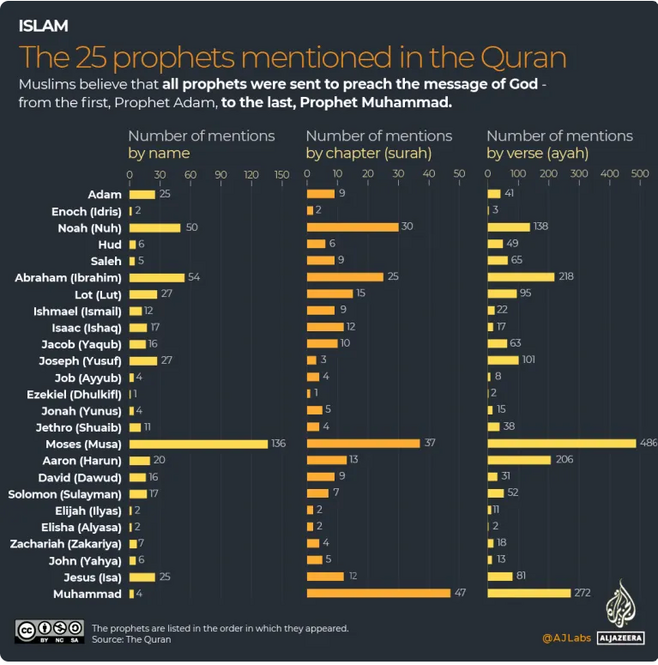
The introduction states the Muslim belief that prophets, from Adam to Muhammad, were sent to preach God’s message. The chart says its rows follow their order of appearance. The table preserves that order and the original name pairings, without independently establishing the identifications.
| Name label | By name | By chapter (surah) | By verse (ayah) |
|---|---|---|---|
| Adam | 25 | 9 | 41 |
| Enoch (Idris) | 2 | 2 | 3 |
| Noah (Nuh) | 50 | 30 | 138 |
| Hud | 6 | 6 | 49 |
| Saleh | 5 | 9 | 65 |
| Abraham (Ibrahim) | 54 | 25 | 218 |
| Lot (Lut) | 27 | 15 | 95 |
| Ishmael (Ismail) | 12 | 9 | 22 |
| Isaac (Ishaq) | 17 | 12 | 17 |
| Jacob (Yaqub) | 16 | 10 | 63 |
| Joseph (Yusuf) | 27 | 3 | 101 |
| Job (Ayyub) | 4 | 4 | 8 |
| Ezekiel (Dhulkifl) | 1 | 1 | 2 |
| Jonah (Yunus) | 4 | 5 | 15 |
| Jethro (Shuaib) | 11 | 4 | 38 |
| Moses (Musa) | 136 | 37 | 486 |
| Aaron (Harun) | 20 | 13 | 206 |
| David (Dawud) | 16 | 9 | 31 |
| Solomon (Sulayman) | 17 | 7 | 52 |
| Elijah (Ilyas) | 2 | 2 | 11 |
| Elisha (Alyasa) | 2 | 2 | 2 |
| Zachariah (Zakariya) | 7 | 4 | 18 |
| John (Yahya) | 6 | 5 | 13 |
| Jesus (Isa) | 25 | 12 | 81 |
| Muhammad | 4 | 47 | 272 |
The chart does not define how indirect references were assigned to chapters or verses. Those columns must not be read as exact name-occurrence counts. Its identities, counts and chronology are reproduced as source claims, not independently established findings.
The Quran at a glance: source overview

The poster describes the Quran as Islam’s central religious text, believed by Muslims to have been revealed by God through Gabriel to Muhammad over 23 years and recited in prayer.
| Measure | Printed total |
|---|---|
| Sections (juz) | 30 |
| Chapters (surahs) | 114 |
| Verses (ayah) | 6236 |
| Pages | 604 |
| Words | 77432 |
The 604-page figure is footnoted “The Al-Madina Al-Munawara Quran (Arabic Edition)”. Page counts depend on the edition: see Quran Foundation’s page-layout guide. The poster provides no counting convention for its word total; it should not be treated as a universal total.
The first revealed verse is labeled Al-’Alaq 1 and rendered “Read, in the Name of your Lord Who created…”; read the verse and translations. The timeline is labeled 23 years of revelation and divides chapters into 86 Meccan and 28 Medinan surahs. Its printed dates are 609 CE / 13 BH (Quran revealed), 622 CE / 1 AH (Hijra from Mecca to Medina), and 632 CE / 11 AH (Prophet’s death). These are transcribed source dates, not an independently reconciled chronology.
The manuscript photograph is captioned as the Sanaa Quran, described by the poster as one of the oldest Quranic manuscripts, dating to the seventh century. The graphic does not identify the pictured folio or provide a manuscript catalogue reference.